


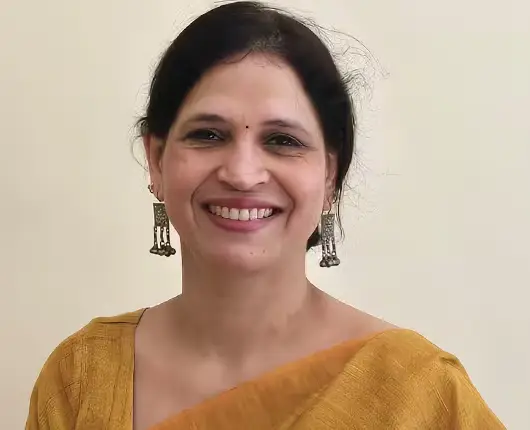
Director & Associate Professor
Anthropology
“There is always more than one side to a story, and more than one answer to a question.” As an educator, Shweta brings archaeology and anthropology into dialogue with lived experience. Her classrooms are spaces where students are encouraged to question disciplinary boundaries, recognise positionality, and engage critically with the world around them.

Archaeology, Culture, and the Liberal Arts as a Way of Thinking
For Dr. Shweta Sinha Deshpande, archaeology has never been merely about the past. It has been a way of understanding how humans remember, belong, migrate, believe, and imagine themselves across time and space. Her work moves fluidly between ancient landscapes and contemporary societies, between material culture and living communities, and between the field and the classroom. What anchors this movement is a commitment to understanding how cultures are forged, sustained, and transformed.
Trained as an archaeologist, her academic journey began with the material traces of South Asian protohistory. Her doctoral work at Deccan College focused on cultural interactions in Central and Western India during the third and second millennia BCE, an inquiry, that refuses to treat cultures as isolated or static. Instead, her work approaches them as relational, dynamic, and interconnected, shaped by networks of exchange, technology, belief, and movement. Her engagement with archaeology has always gone beyond excavation; she has been deeply invested in how archaeological knowledge is produced, framed, and mobilised, how narratives gain authority, and how the past is appropriated in the present. Her work has contributed significantly to rethinking Chalcolithic South Asia, particularly in terms of crafts, technologies, interaction networks, and regional trajectories.
Over time, this sensitivity to interaction expanded beyond protohistoric societies to include contemporary questions of globalization, migration, religion, education, and identity. Whether examining Chalcolithic technologies or present-day religious iconography, her work consistently asks: what cultural baggage do people carry, often unconsciously, and how does it shape the worlds they inhabit?
One of her significant pedagogical contributions has been the development of the CBALwRAS model (Curriculum-Based Academic Learning with Research, Action, and Service), a framework that integrates curriculum, community partnership, and research for social impact. This model reflects her belief that education must be embedded in social realities and that knowledge-making carries responsibility.
Currently serving as the Director and Associate Professor at the Symbiosis School for Liberal Arts (SSLA), Shweta has a long and formative engagement with Liberal Arts education since 2008. Over the years, she has played a central role in shaping SSLA’s academic vision, curriculum design, community engagement, and internationalisation.
She is engaged in teaching courses across archaeology, anthropology, migration studies, history, along with interdisciplinary courses.